Spit, Sauce, and Neighborhood Secrets: The Unwritten Rules of Finding Your City's Best Döner
There is a moment every Turkish-American has experienced at least once. You're sitting in a new city, maybe you just moved there for work or college, and someone — a well-meaning coworker, a new friend, a Yelp review you probably should not have trusted — tells you they know a great Turkish place. They are excited. They are proud of themselves. You follow them there, you sit down, and then you stare at what lands on your plate: a pita wrap stuffed with something technically described as döner but bearing roughly the same relationship to the real thing as a grocery store birthday cake does to your annenin pastası.
You smile. You say thank you. You eat it anyway. And then you go home and spend forty-five minutes searching Google Maps for something better.
This is the döner diaspora experience. And honestly? It's a whole thing.
What You're Actually Looking For (Even If You Can't Explain It)
The problem with finding good döner in America is that the criteria are almost entirely vibes-based, which makes it impossible to explain to anyone who didn't grow up eating it. You can't just say "I want it to taste like Ankara" because that means nothing to your coworker from Ohio. But you know it when you see it — and more importantly, you know it when you taste it.
That said, there are real, tangible markers that separate a legitimate döner operation from a tourist trap with a rotating meat cone:
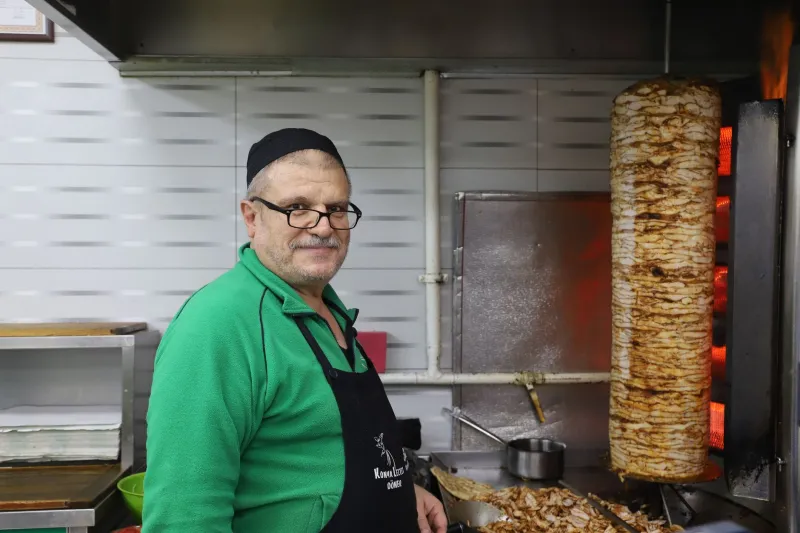
The rotisserie itself. Is it clean? Not sterile-hospital clean, but actively cared-for clean? The way the meat is stacked, whether it's properly marinated, how the outer layer is being shaved versus hacked — these details tell you everything about whether the person behind the counter was trained by someone who actually knew what they were doing.
The bread situation. This is non-negotiable. If the bread is cold, pre-sliced, or — God help us — a flour tortilla, you are already in trouble. Proper döner bread should be fresh, slightly warm, and sturdy enough to hold everything together without turning into a soggy disaster two bites in.
The sauce ratio. Every Turkish family has its own sauce theology, and döner shops are no different. Too much yogurt sauce makes it soupy. Too little and it's dry. The correct amount is the exact amount your uncle used, which you cannot measure but will immediately recognize.
The owner's story. Ask where they're from. This isn't rude — it's research. Someone who trained in Istanbul or Bursa or spent years working in a proper kebapçı before opening their own place is going to approach the craft differently than someone who learned from a YouTube tutorial.
The Neighborhood Hunt Is Half the Point
Here's the thing nobody tells you: finding your city's döner spot is less like searching for a restaurant and more like being initiated into a secret society. The best places almost never have great Yelp pages. They're often in strip malls next to a dry cleaner or a phone repair shop. The sign might be slightly faded. There's probably a Turkish-language newspaper somewhere near the register.
In places like New Jersey — Paterson, specifically — you can practically follow the smell. The Turkish community there is dense enough that word travels fast and bad döner does not survive. In Houston's Hillcroft corridor, the competition is stiff and the standards are kept high by a customer base that will absolutely tell you to your face if something is off. In Chicago, you're looking toward the north side neighborhoods where the Turkish and Middle Eastern communities overlap. In LA, it takes more digging, but Glendale and parts of the San Fernando Valley will reward the patient searcher.
The pattern, wherever you go, is the same: find the Turkish community, find the mosque, find the grocery store that sells Ülker biscuits, and then ask. Someone will point you in the right direction. They always do.
The Impossible Customer: A Döner Owner's Perspective
We talked to a few döner shop owners — people who have been doing this for years, who woke up early every morning to prep the meat, who built their menus from memory and muscle — and they all said some version of the same thing: Turkish-American customers are the most loyal customers they have, and also the most exhausting.
"Everyone comes in and says 'this is good, but my uncle's was better,'" laughed one owner who's been running his spot in New Jersey for over a decade. "I tell them, bring me your uncle. Let him work here. Then we'll see."
The issue, as he explained it, is that döner is intensely personal. Every family that came from Turkey brought their own version with them — regional differences, spice variations, the specific way someone's grandmother insisted on preparing the marinade. There is no single canonical döner. There's just the one you grew up with, and then everything else, ranked accordingly.
Another owner, who opened his place in Texas after years working in Germany's massive Turkish döner scene, pointed out that American customers also come with an additional layer of expectation built up by German döner culture — which is its own distinct thing and a whole separate argument. "The German version is different. More toppings, different bread. Some people want that. Some people get angry if you even suggest it. I've learned to ask first."
The Markers You Learn to Trust
After enough searching, you develop instincts. You start to notice things. A hand-written menu in Turkish is a good sign — it means the owner isn't performing authenticity for outsiders, they're just running their restaurant the way they know how. A TV in the corner playing Turkish news or a dizi rerun? Even better. A jar of biber salçası behind the counter that looks like it's actually being used? You're in the right place.
You also learn the red flags. Döner listed as a "gyro" on the menu without any acknowledgment of the difference. Meat that's been pre-sliced and reheated. Garlic sauce from a bottle. A staff that seems surprised when you order in Turkish.
None of these things are necessarily dealbreakers on their own — sometimes you're hungry and the gyro place is what's open. But when you're on the hunt for the real thing, they matter.
The Spot You Find Is the Spot You Protect
Here's the unspoken rule of the döner diaspora: when you find your spot, you protect it. You tell your Turkish friends. You don't post it on Reddit. You don't put it in a "hidden gems" listicle that's going to bring in a crowd that doesn't know how to order. You keep it in the community, because that's how it stays good.
The best döner places in America aren't famous. They're just known — by the right people, in the right circles, passed along through the same invisible network that's been keeping Turkish-American culture alive in this country for decades.
You find your spot. You become a regular. You tip well. You argue with the owner about the sauce.
And eventually, one day, some newly arrived Turkish-American is going to walk in looking lost and hungry, and you're going to be the one who tells them: yeah, this is the place. You found it.