Nobody's Baklava Is Wrong (But Nobody's Baklava Is Right Either)
It started, as most Turkish-American arguments do, at a potluck.
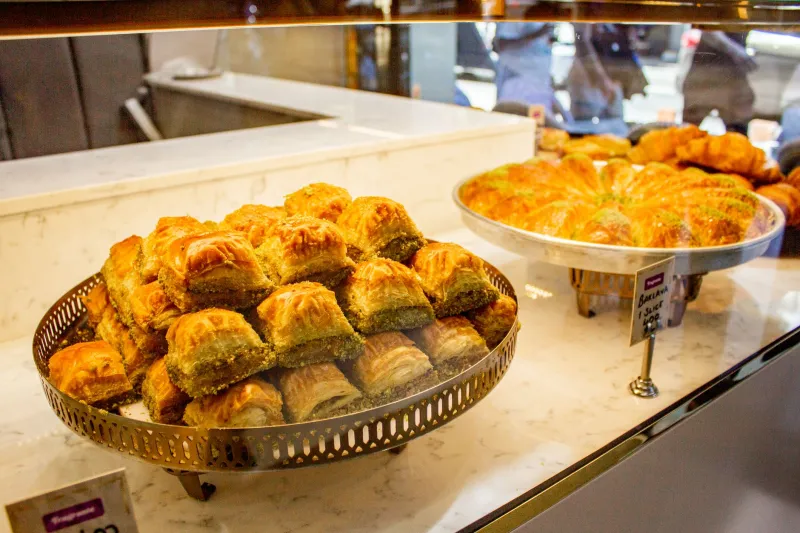
Somebody brought baklava from a Greek-owned bakery in Astoria. Somebody else brought a tray their aunt had overnighted from a pastry shop in Gaziantep. A third person — brave, possibly reckless — had made their own from scratch using a recipe they found on YouTube. Within fifteen minutes, the baklava table had become a low-key diplomatic incident. Voices weren't raised. Nobody stormed out. But the looks exchanged across that folding table? Those were doing a lot of heavy lifting.
Welcome to the great Turkish-American authenticity debate, where the stakes are technically just dessert and emotionally everything.
The Antep Contingent Will Not Be Silenced
If you have any connection to Gaziantep — whether you were born there, your parents were born there, or you just once dated someone whose cousin is from there — you already know that Antep baklava is, in the minds of its devotees, less a food item and more a sacred text. The pistachios are a specific shade of green. The syrup hits a particular sweetness-to-citrus ratio. The layers are so thin they're practically theoretical.
Antep loyalists in the US have an almost missionary quality about them. They will find the one Turkish grocery store in a 40-mile radius that stocks proper Antep fıstığı, pay an amount for pistachios that would make their American coworkers physically recoil, and then present the finished product with the quiet confidence of someone who knows they've already won the argument before it started.
And honestly? They're not wrong. But here's the thing — they're not the only ones who aren't wrong.
Meanwhile, in Every Other Region of Turkey
Gaziantep gets the press, but Turkey is enormous, and baklava looks different depending on which corner of it your family called home. Istanbul-style baklava tends to lean butterier, richer, with a syrup that's slightly less aggressive. Some families from the Aegean coast make versions with walnuts instead of pistachios — a choice that will cause an Antep person to go very still and quiet in the way that is somehow more alarming than if they'd just yelled.
Then there's the whole debate about thickness. Thin layers vs. slightly chunkier layers. Syrup poured hot over hot vs. cold over hot. Whether the tray should rest overnight or be served same-day. Each of these micro-decisions carries the full weight of somebody's grandmother's reputation, and that is not a thing you mess with lightly.
Turkish-Americans from different regional backgrounds have essentially inherited these disagreements along with their recipes. They didn't choose this. It chose them.
The Second-Generation Problem (And Why It's Actually Kind of Beautiful)
Here's where things get genuinely interesting. First-generation immigrants often have a clear internal reference point — baklava tastes like this because that's what it tasted like at home, full stop. But second-generation Turkish-Americans? Their relationship with authenticity is way more complicated and, honestly, way more honest.
For a lot of us who grew up here, our earliest baklava memory might be from a Turkish festival in New Jersey, or a halal market in a strip mall somewhere in Virginia, or a Trader Joe's impulse buy that we knew was wrong but ate anyway because it was 11pm and it was there. Our nostalgia isn't attached to a single geographic origin — it's attached to a feeling, a moment, a specific afternoon in someone's kitchen watching someone's teyze move with terrifying efficiency through a process that looked like it required a culinary degree.
So when second-gen Turkish-Americans make or seek out baklava, what exactly are we chasing? The honest answer is: something that tastes like belonging. And that's a moving target.
The Authenticity Trap
Here's the uncomfortable truth that nobody at the potluck wants to say out loud: authenticity is kind of a myth, or at least it's a lot more fluid than we pretend.
Baklava itself has a history that stretches across the Ottoman Empire and beyond, absorbing influences from dozens of cultures and kitchens over centuries. The version your great-grandmother made in a village in southeastern Turkey was already the product of generations of adaptation. The version her grandmother made was different still. Food doesn't sit still. It never has.
When Turkish-Americans argue about whose baklava is more authentic, we're really arguing about which moment in a very long, constantly evolving story deserves to be frozen and called the real version. And the answer, if we're being honest, is none of them — and all of them.
Why the Argument Is Actually the Point
None of this means the debate is pointless. Quite the opposite.
The baklava argument — and all the arguments like it, about köfte and börek and whether your mom's cacık recipe is better than his mom's cacık recipe — is one of the ways Turkish-American communities stay in conversation with each other and with the culture they're trying to carry forward. It's a living connection. It's proof that we care.
When a Turkish-American in Houston insists that the baklava at a local Mediterranean restaurant doesn't taste right, they're not just complaining about pastry. They're asserting that they remember something, that they come from somewhere, that there's a standard worth holding onto even when you're 6,000 miles from wherever that standard was set. That's not stubbornness. That's identity work, dressed up in phyllo dough.
And when someone else — maybe a third-generation kid who grew up eating baklava from a Costco holiday platter — tries their first real Antep-style piece and their eyes go wide? That's the culture reaching across time and geography and doing exactly what culture is supposed to do.
So Who Wins?
Nobody. Everybody. It depends on the day.
The baklava at that potluck all got eaten, by the way. Every single tray, including the YouTube recipe one, which turned out to be genuinely pretty good even though nobody wanted to admit it. People went back for seconds from all three. Someone asked for the Greek bakery's address. The Antep loyalist quietly took a piece of the homemade version when they thought no one was looking.
That's the thing about Turkish-Americans and food: the arguing is real, but so is the appetite. We can debate authenticity all night and still share a table. We can disagree about whose version is better and still recognize each other in the act of caring this much about it in the first place.
The baklava debate will never be resolved. It was never supposed to be. It's not a problem to solve — it's a conversation to keep having, one syrup-sticky tray at a time.