Meze Wars: How Turkish Appetizers Took Over American Tables and Why the Hummus Argument Never Ends
The Appetizer That Became the Whole Meal
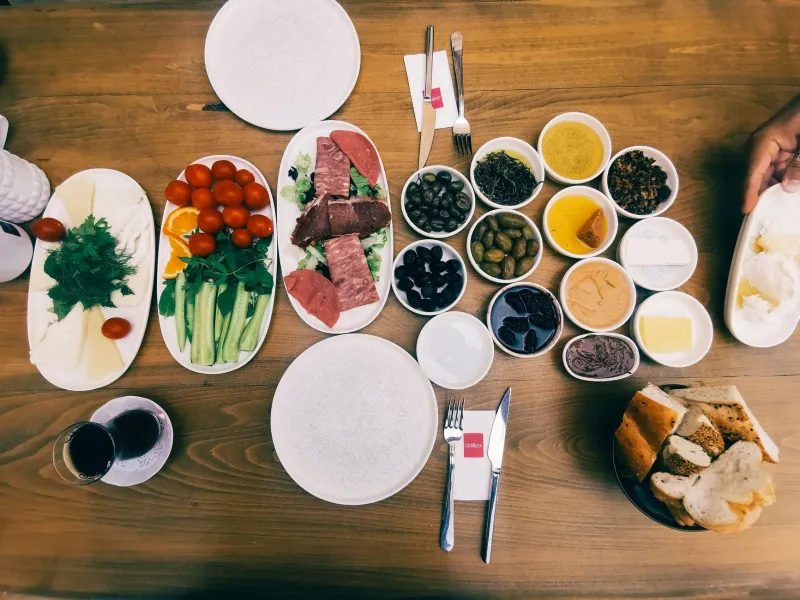
Somewhere between 2015 and now, the American dinner table quietly transformed. The bread basket got replaced by a wooden board. Ranch dip took a backseat to something smoother, tangier, more interesting. Suddenly everyone's hosting "small plates nights," and there's a little ceramic dish of something purple and roasted sitting next to something white and creamy and something green that may or may not have olives in it.
Congratulations, America. You've discovered meze. Or mezze. Or maza. The spelling alone is enough to start an argument, and trust us — the arguments don't stop there.
For Turkish families in the US, watching meze go mainstream has been a deeply mixed experience. On one hand, it's genuinely exciting. On the other hand, there's a particular kind of pain that comes from seeing your culture's most beloved tradition get rebranded as a "Mediterranean grazing board" at a chain restaurant in suburban Ohio. We've all felt it. We're going to talk about it.
What Meze Actually Is (And Isn't)
Let's get something straight from the jump. Meze isn't just appetizers. That translation is technically accurate but spiritually wrong. Meze is a philosophy. It's the understanding that the best part of any meal is the beginning — the part where everyone is still hungry and excited, where conversation flows easily, where you're not yet committed to a single dish but instead grazing across a dozen small ones like some kind of extremely sophisticated goat.
In Turkish tradition, meze is inseparable from rakı — the anise-flavored spirit that is essentially Turkey's national drink. The combination is called rakı sofrası, literally a rakı table, and it's less a meal and more an event. You don't rush a rakı table. You sit for hours. You talk. You argue about politics and football and family. You eat slowly and drink slowly and the whole thing is an exercise in civilized human connection.
None of this is captured by the phrase "Mediterranean snack board."
The Classics, Ranked by How Offended Someone Will Be
Turkish meze is its own universe, distinct from Greek, Lebanese, or any other regional variation — though it shares DNA with all of them, because that's what happens when empires rise and fall and trade routes exist. Here are some of the essential Turkish players:
Haydari — A thick, garlicky yogurt dip with dried mint and sometimes walnuts. Creamy, punchy, and dangerously addictive. If you've only ever had regular tzatziki, haydari is its more intense, more interesting cousin.
Ezme — A finely chopped tomato and pepper salad, usually spicy, always bright. It's technically a salad but functions as a dip. Turkish cuisine doesn't care about your categories.
Patlıcan salatası — Roasted eggplant salad, smoky and silky. The eggplant is charred directly over flame until it collapses into itself, then mixed with lemon, garlic, and olive oil. Americans have started calling everything in this family "baba ganoush," which is a Lebanese preparation and not quite the same thing, and yes, this does bother people.
Arnavut ciğeri — Fried Albanian-style liver, cubed and spiced. Not for the faint of heart, extremely for the adventurous.
Dolma — Stuffed grape leaves, rice and herbs wrapped tight. Every Turkish grandmother has a version she considers definitive. She is correct.
Beyaz peynir — White cheese, similar to feta but Turkish and therefore, per Turkish people, superior to feta. This is another argument we're not settling today.
Okay, Let's Talk About Hummus
Here it is. The thing everyone's been waiting for. The conversation that has derailed more dinner parties than any other food-related topic in recent memory.
Who owns hummus?
The honest, historically accurate, deeply unsatisfying answer is: no single country does. Hummus — ground chickpeas with tahini, lemon, and garlic — appears across the cuisines of Turkey, Lebanon, Israel, Palestine, Syria, Egypt, and Greece, with each region claiming some version of it as their own. The word itself is Arabic for chickpea. The dish predates modern borders by centuries.
In the US, hummus got popularized largely through Israeli and Lebanese restaurant culture, which is why many Americans associate it primarily with those cuisines. This drives Turkish people absolutely up the wall, not because Turks invented it (the ownership claim is murky for everyone), but because nohut ezmesi — the Turkish chickpea preparation — exists and is delicious and deserves its own recognition.
And here's the thing: Turkish hummus is often made differently. Less tahini, sometimes with butter, occasionally topped with pastırma (cured beef) or spicy red pepper flakes and olive oil. It's richer, warmer, more of a composed dish than a dip. When you put it next to the mass-produced tub from the grocery store that calls itself "authentic Mediterranean," it's a completely different experience.
"I've stopped trying to explain it," says Selin T., who runs a Turkish catering operation out of the Dallas area. "I just make it my way and let people taste it. Once they do, they stop arguing about what it's called."
The Restaurant Owners Navigating the Authenticity Tightrope
For Turkish restaurant owners across the US, the meze moment has been both a gift and a challenge. On the positive side, American diners are more adventurous than ever. The success of Mediterranean food broadly has opened doors for Turkish cuisine specifically — people come in already knowing what to expect from the small-plates format, already comfortable with the idea of sharing.
The challenge is the pressure to simplify. "People see 'Mediterranean' on a menu and they have a picture in their head," explains Mehmet A., who owns a Turkish restaurant in the Seattle area. "They expect hummus, pita, maybe some falafel. When I put haydari on the menu, I have to explain what it is. Which I'm happy to do! But it means the food has to do double duty — it has to taste good and teach."
Some restaurateurs have leaned into Americanization strategically. Others have held firm on traditional preparations, accepting a smaller but more devoted customer base. Neither approach is wrong. Both approaches will generate strong opinions from Turkish community members online.
The Home Cook Perspective (Aka the Real Authority)
Ask any Turkish-American home cook and they'll tell you the same thing: the best meze has never been in a restaurant. It's been at someone's house, made by someone's mother or grandmother or that one uncle who somehow became the family's best cook, served on mismatched dishes with too much bread and not enough time to eat everything before someone starts doing dishes.
Replicating that in the US is its own project. Some ingredients are easier to find now — Turkish grocery stores have expanded in cities like Houston, Chicago, New York, and LA, and even mainstream supermarkets carry more than they used to. But certain things remain a hunt. Good beyaz peynir. Proper pastırma. The right kind of red pepper paste (biber salçası) that forms the backbone of half the dishes on any meze table.
"I make my own salça now," says Gülden H., a home cook in New Jersey who hosts elaborate meze dinners for her friend group, which is roughly 40% Turkish and 60% "people who have been adopted into Turkish food culture." "I roast the peppers myself. It takes forever. But once you taste the difference, you can't go back to the jar stuff."
Why the Fighting Is Actually the Point
Here's the thing about meze culture that Americans are slowly figuring out: the arguing is part of the experience. Who makes the best dolma. Whether the eggplant is smoky enough. Whether hummus belongs on this table at all. Whether your haydari has too much garlic or not enough.
These are not problems to be solved. They're conversations to be had, loudly, over small plates and good drinks, for as long as possible.
Meze was never about the food alone. It was always about the table. About gathering people around something delicious and letting the hours disappear. The fact that American dinner culture is catching on — even if it comes with some naming confusion and a lot of misattributed recipes — means more people are sitting down together, eating slowly, and arguing about something that actually matters.
Welcome to the table. Pull up a chair. Someone will fight you about the hummus, but the haydari is incredible.