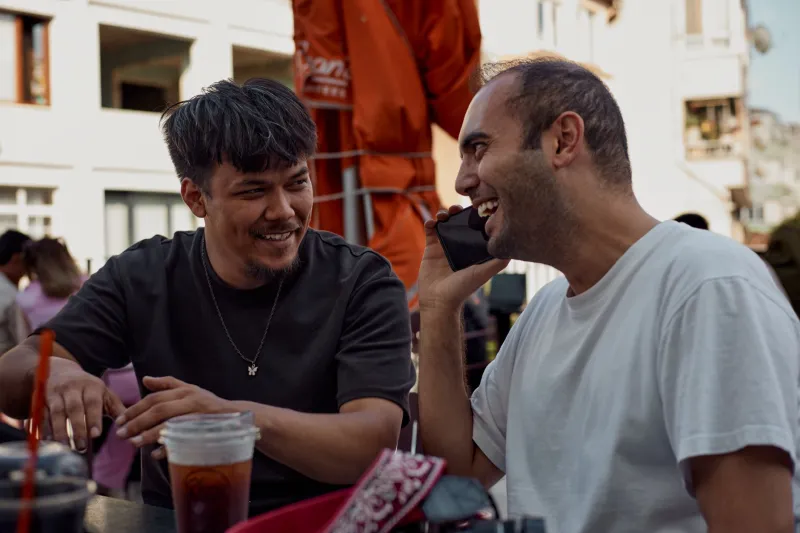
Annem Arıyor: Decoding the Turkish Parent Phone Call That's Actually a Covert Operation

It always starts so innocently. Your phone buzzes. Mom's face lights up the screen — maybe it's that slightly blurry selfie she texted you from a family gathering two years ago, the one she insisted you save as her contact photo. You think: I have fifteen minutes before my meeting. Easy.
Reader, you do not have fifteen minutes.
For Turkish-American kids navigating life in the US, the check-in call home is not a phone call. It is an experience. It is an event. It is, depending on your family's particular flavor of love, something between a therapy session you didn't book and a congressional hearing about your personal life.
"İyiyim" and Other Fictions
Let's start with the basics. You say iyiyim — I'm fine — and your Turkish parent hears approximately none of it. "Fine" is not a data point they accept. Fine is a placeholder. Fine is what you say before the real conversation starts.
Within sixty seconds, the follow-up questions begin. Are you really fine? Have you eaten? Not just today — have you been eating properly? What does properly mean? It means: have you had a warm meal, ideally one involving some form of lentil soup, because apparently lentil soup is the metric by which all wellness is measured.
Melisa, a 26-year-old based in Chicago, told us her mom once called three times in a single day because Melisa's voice sounded "tired" on the first call. "She was convinced I was sick and lying about it. I was tired. I had a deadline. But by the third call I was basically reporting my symptoms like I was on a hotline."
This is not unusual. This is Tuesday.
The Interrogation Spiral
Here's how it goes, roughly, and in this order:
Phase One: Health Inventory. Eating, sleeping, whether you have a coat on even though you're inside your own apartment. This phase lasts longer than you expect.
Phase Two: The Career Check. This one is delivered casually, like it just occurred to them. How is work? Is your boss treating you well? Have you thought about what's next? This last question is technically about career advancement but is spiritually about whether you're building a stable enough life to one day move back closer to the family.
Phase Three: Relationship Status, Delivered Sideways. Nobody in a Turkish household asks "are you seeing anyone" directly. That would be too easy. Instead it comes in as: "Your cousin Defne just got engaged, did you see the photos?" Pause. "She met him at work, actually." Longer pause. Silence that somehow communicates an entire paragraph.
Phase Four: The Guilt Calibration. This is where you learn how long it's been since your last call. Not because they tell you — because they mention, offhandedly, that your aunt asked about you and they "didn't know what to say." Translation: it has been too long and multiple relatives are aware of this.
Deniz, a 31-year-old in New York, has started keeping a mental log. "I know that if I don't call for ten days, someone in the extended family has been briefed. I don't know how. It just happens. The network activates."
Love, Encoded
Here's the thing, though — and this is where it gets complicated — none of it is actually about the questions.
The food questions are not about food. They are about whether you are okay in a country far from home, eating meals alone, without someone who loves you nearby to make sure you're nourished. The career questions are not skepticism. They are anxiety dressed up as practicality, from people who built a life in a new place and want yours to be easier than theirs was. The relationship questions? That's just love with bad timing.
Turkish parents — and let's be honest, a lot of immigrant parents broadly — communicate care through logistics. Through did you eat, through do you need money, through I saw it's going to be cold there this week. Saying "I miss you" straight out is sometimes harder than texting a screenshot of a weather forecast for your city.
And diaspora kids, fluent in two cultures and sometimes fully comfortable in neither, often don't have the language to bridge that gap cleanly. You've built a life that makes sense in English, in America, in your particular ZIP code. Your parents built their understanding of you in a different context. The phone call is where those two worlds attempt, imperfectly and loudly, to meet.
The Once-a-Month Caller
Let's talk about guilt, because we have to.
There is a specific kind of Turkish-American guilt that hits when you realize you haven't called in a while. It's not dramatic. It's not a breakdown. It's just this low hum, somewhere around Sunday afternoon, that sounds a little like they're not going to be around forever and a lot like I should call.
And then you call, and it's forty-five minutes, and afterward you feel simultaneously exhausted and weirdly grounded. Like you got yelled at and hugged at the same time. Which, honestly, is kind of the whole thing.
Kerem, 29, from Houston, put it simply: "Every time I hang up I'm annoyed for like ten minutes. And then I'm really glad I called. Every single time."
A Field Guide for the Uninitiated
If you're a non-Turkish partner, roommate, or coworker who has witnessed one of these calls — the pacing around the apartment, the sudden switch to rapid-fire Turkish, the expression that cycles through confusion, mild offense, and warm laughter within the same ninety seconds — welcome. You are seeing something real.
This is not dysfunction. This is a communication system with its own grammar, its own subtext, its own emotional logic. It is loud and it is long and it will almost certainly run over whatever you had planned.
But somewhere underneath the lentil soup interrogation and the cousin-engagement drop and the weather screenshot sent at 11pm, there's a family that misses you. That checks on you through the only channel they know how to use. That will call again in three days if you sound even slightly off.
Pick up. You've got time.