Scissors, Straight Razors, and Straight Talk: The Turkish Barbershop Is Not Just a Haircut
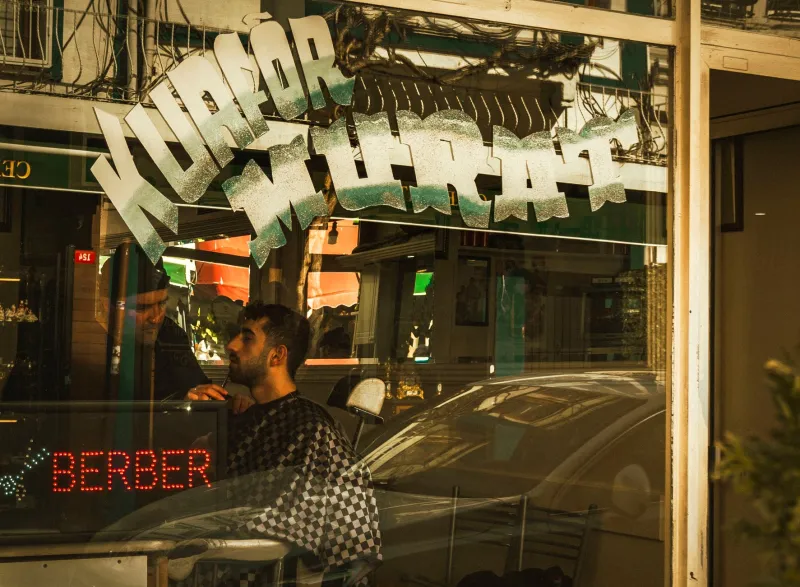
There's a moment that every Turkish-American man knows. You sit down in the chair, the barber snaps the cape around your neck like he's knighting you, and before he's even picked up a comb, he says — "N'aber abi, her şey yolunda mı?" — and suddenly you're talking about your job, your mom's health, whether your cousin made the right call moving to Texas, and the general state of the world economy. By the time he's done with the back of your neck, you've processed more than you have in six months of group chats.
The Turkish barbershop is a cultural institution that doesn't get nearly enough credit. And in the diaspora, it somehow hits even harder.
You Drive How Far for a Haircut?
Ask any Turkish-American man where he gets his hair cut and prepare for a very specific kind of pride to appear on his face. It's not the pride of someone who found a great Yelp deal. It's the pride of someone who has discovered something real.
"There's this place in Paterson," a guy in Philadelphia will tell you with complete sincerity. "I drive up there every six weeks." You do the math. That's over an hour each way, for a haircut. But here's the thing — nobody thinks this is weird. Not in our world.
Because it's not really about the haircut. It's about Hüseyin Abi, who has been cutting hair in the same spot for eighteen years, who remembers your father, who gives you a glass of çay while you wait, and who will tell you — without being asked — exactly what he thinks about the decision you've been quietly agonizing over for three months. You didn't even mention the decision. He just knows.
That's the thing about a good Turkish berber. They are, without question, operating on a frequency the rest of us can't access.
The Unspoken Hierarchy of the Waiting Chairs
If you've never sat in a Turkish barbershop waiting area, let me paint you a picture. There's a row of chairs along the wall. They are almost always slightly mismatched. There is a TV in the corner playing either a Turkish news channel, a football match, or a dizi that nobody is fully watching but everyone is half-following. There are magazines from 2019.
And then there is the order.
Nobody officially tracks it. There is no ticket system. There is no app. But everyone in that room knows exactly where they stand in the queue, and there is an entire shadow government of social cues managing the whole operation. The older you are, the more likely you are to get a subtle nod that means you're next even if you arrived after three other people. Nobody questions this. It's not favoritism — it's just how things work, and honestly, it works.
The real power move, though, is being the guy the barber greets by name before you've even fully walked through the door. That's not just a haircut appointment. That's a relationship. That's years of investment. That's cultural capital you cannot purchase on Groupon.
What Actually Gets Said in That Chair
Here's a partial list of topics that have been seriously discussed in Turkish barbershops across the United States, compiled from entirely unscientific personal research:
- Whether it's smarter to buy or rent right now (the barber will have a firm opinion)
- What went wrong with the last Turkish national team match
- Your father's generation versus your generation and who had it harder
- Whether you should call your mother back tonight or wait until tomorrow (call her tonight)
- The neighborhood in Istanbul that's changing too fast
- The neighborhood in New Jersey that's changing too fast
- A mutual acquaintance who made a questionable financial decision
- Whether the new place down the street is actually good or just looks good
- Your marriage prospects, if you are single
- Your marriage, if you are married
None of this is solicited. All of it lands. Because a Turkish barber has, over the course of decades, developed a read on human nature that most licensed therapists would genuinely envy. They've heard everything. They've seen the same problems cycle through different men in different decades. They give advice with the calm confidence of someone who has watched the same movie enough times to know exactly how it ends.
The Hot Towel Is a Ritual, Not a Service
Let's talk about the straight razor shave for a second, because it deserves its own moment of appreciation.
In most American barbershops, the straight razor is a premium add-on. You pay extra, you feel fancy, it's a nice experience. In a Turkish barbershop, it's just what happens. It's part of the deal. The barber heats the towel, wraps your face, lets the steam do its work, and then — with a blade that looks like it belongs in a period drama — shaves you so cleanly you feel like a different person.
There's something almost meditative about it. You can't talk during the straight razor part. You have to be still. You have to trust completely. And for a community that is constantly navigating two cultures, two languages, two sets of expectations — that five minutes of enforced stillness, of being cared for by someone who asks nothing except that you sit quietly — is more restorative than it has any right to be.
The Barbershop as Community Center
In cities with large Turkish-American populations — Paterson, parts of Brooklyn, pockets of Chicago, Houston, the DC suburbs — the Turkish barbershop functions as something the community doesn't always have in other forms: a neutral gathering space. Not a restaurant where you need to order. Not a mosque where there are expectations. Not a family home where the politics are complicated.
Just a room where men come in, sit down, and talk. Where news travels. Where someone always knows someone who knows something. Where a new arrival to the city can walk in and, within twenty minutes, have a lead on an apartment, a job contact, and an invitation to someone's cousin's birthday dinner.
This is not an accident. The berber dükkanı has always been this in Turkish culture — a place of informal civic life. The diaspora just carried it across an ocean and planted it on American soil, and somehow it took root exactly the same way.
Why We Keep Going Back
You could get a technically superior haircut somewhere else. Probably cheaper, definitely faster, with a booking app and a text reminder and a Spotify playlist curated for the vibe. And sometimes you do. Life is busy.
But you always come back to the Turkish barbershop. Because Hüseyin Abi noticed last time that you looked tired, and he didn't say anything, but he gave you a longer shoulder massage than usual. Because the guy who was waiting when you arrived is someone you've seen there a dozen times and you don't know his name but you know his whole situation. Because there's çay. Because it smells like the combination of aftershave and hair product that, for some reason, smells like being twelve years old and watching your baba get his hair cut on a Saturday morning.
Because some things don't need to be optimized. Some things just need to stay exactly the way they are.
The Turkish barbershop is one of them.