You Will Not Leave This House Empty-Handed: The Beautiful Chaos of Turkish-American Gift Culture
Let's set the scene. You're heading to a friend's place for a casual Saturday dinner. Your American coworker brings a single bottle of wine, hands it over at the door, and is immediately celebrated as a thoughtful guest. You, meanwhile, have been standing in the Trader Joe's baklava aisle for twenty-five minutes, internally screaming, because you already have homemade börek in the car, a box of lokum from the Turkish grocery in Paterson, and a bouquet of flowers you're now second-guessing because your aunt once said flowers at dinner are "a little funeral-y."
This is not anxiety. This is culture.
The Guilt Starts Before You Even Leave the House
For Turkish-Americans, arriving somewhere empty-handed isn't just a faux pas — it's a personality flaw. It's the kind of thing that gets mentioned in hushed tones at family gatherings for years. "Remember when Kemal showed up to the engagement party with nothing? Just himself. Just Kemal." Nobody forgets. Nobody forgives.
So you bring something. You always bring something. The question is never whether to bring a gift. The question is whether what you're bringing is enough, appropriate, impressive without being showy, generous without being weird, and — crucially — whether it will survive the inevitable moment when the host tries to give it back to you.
Because that's the other half of this equation that nobody outside the culture fully understands.
The Rejection-Acceptance Dance Nobody Taught You But Everyone Knows
You hand over your carefully chosen gift. The host's eyes light up. They thank you profusely. And then — right on cue — they try to hand it back.
"No no no, you didn't have to, take it home."
You refuse. They insist. You refuse harder. They insist harder. This goes on for somewhere between thirty seconds and four minutes depending on the seniority of the people involved. Eventually, the gift is accepted, but only after both parties have performed the full ritual of rejection and counter-rejection. If you accept the gift back on the first offer, you've misread the room entirely. If you never push back at all, you've been rude. There is a precise middle path, and it is entirely unwritten.
American friends who witness this for the first time look genuinely confused. "Do they want it or not?" Yes. Obviously yes. That's not the point.
What You Bring Says Everything About You
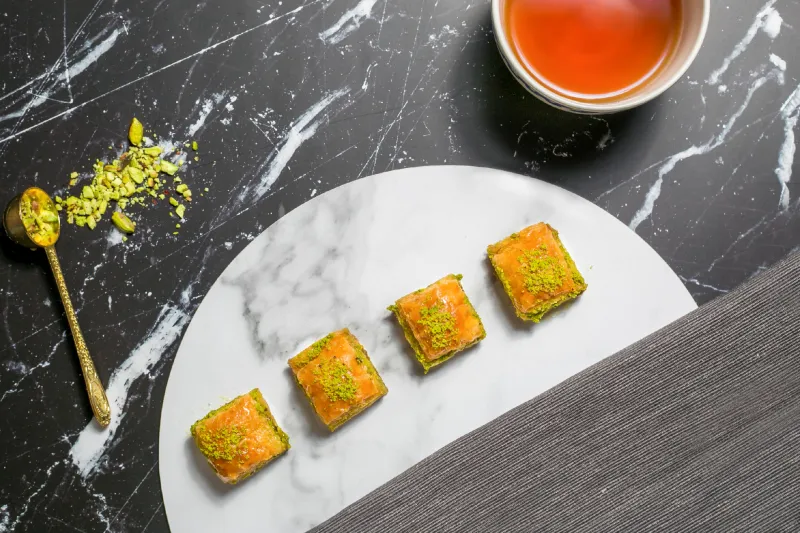
The actual contents of the gift are a whole separate negotiation. Sweets are safe, but not just any sweets. Bringing a box of Russell Stover chocolates to a Turkish household is technically a gift in the same way that technically, yes, you did show up. Bringing something from a Turkish bakery — real Turkish delight, a proper box of fıstıklı baklava, anything wrapped in that specific crinkly gold paper — signals that you understand what you're doing.
Fruit is respected. A nice melon, some cherries, a bag of figs if you can find them — these land well, especially with older guests. Flowers are acceptable but come with their own subtext depending on type and number. And if you're bringing something homemade, you've either hit a home run or accidentally started a cooking competition, because now the host feels obligated to also have made something incredible, and suddenly everyone's in the kitchen comparing börek techniques at 8 PM on a Friday.
Alcohol is situational in ways that require their own separate article.
The Leftover Economy Is Real
Here's where it gets truly chaotic: the end of the night.
You came with gifts. You ate. You laughed. You had çay approximately six times. And now you are being sent home with containers. Actual Tupperware — sometimes the good Tupperware, sometimes repurposed yogurt tubs — filled with food that you definitely did not bring. The host has packaged up portions of everything they made, plus possibly some of what you brought, and is now loading your arms like you're a moving truck.
"Take the pilav, you'll have it for lunch." You don't need the pilav. You have a full refrigerator. You also absolutely are taking the pilav.
The Turkish-American gift economy runs on a kind of perpetual motion: things come in, things go out, nothing is ever fully given or fully kept. It's generous in a way that's almost aggressive. Hospitality here isn't a vibe — it's a contact sport.
Second-Generation Stress Is Its Own Category
For those of us who grew up Turkish-American, there's an added layer: navigating these rules in contexts where nobody else is playing by them. You show up to your college roommate's Friendsgiving with a full tray of homemade kadayıf and a bag of Turkish tea, and people look at you like you've brought luggage to a potluck. Which, fair.
Or you go the other direction — you've spent so long in American social settings that you start to dial it back, bring a single candle or a card, and then spend the entire evening quietly haunted by the ghost of your grandmother's disapproving face.
There's no clean resolution here. You are perpetually calibrating.
Why It's Actually Kind of Wonderful
For all the anxiety it generates, there's something genuinely beautiful about a culture where showing up for people is taken this seriously. Where the act of bringing something — anything — is treated as a statement of care rather than just a social checkbox. Where hosts pack your bags at the end of the night not because they're trying to get rid of you, but because feeding people and sending them home full is how love gets expressed.
Your American friends might not fully get why you spent forty minutes picking out the right box of lokum. But when you show up with it, and the host's eyes do that thing where they light up even as they're already telling you it was too much — you get it. You've always gotten it.
And yes, you're taking the pilav home. You were always taking the pilav home.