Çay vs. Kahve: The Hot Beverage Loyalty Test Every Turkish-American Fails Eventually
Let's get one thing straight before we go any further: nobody in this conversation is just talking about a drink.
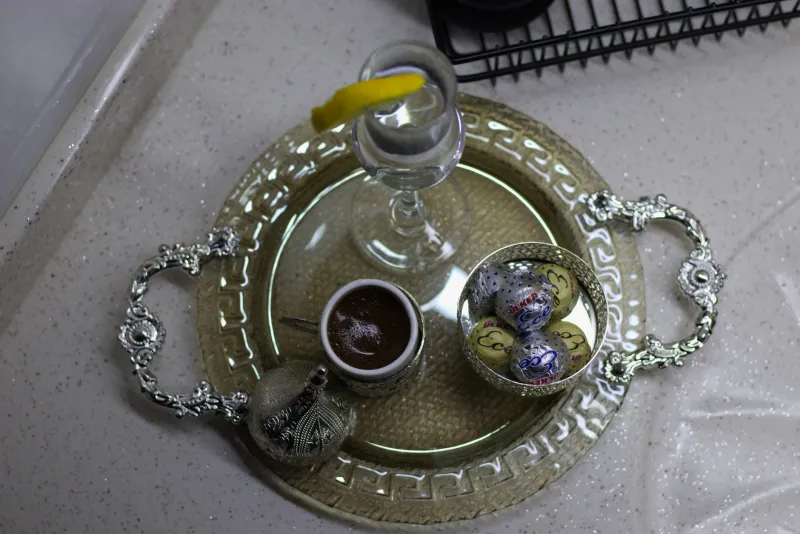
When a Turkish person asks whether you want çay or kahve, they are not simply offering you a warm beverage. They are administering a personality assessment. A loyalty screening. A soft interrogation that will be analyzed, compared to previous answers, and quietly filed away for future reference. The cup you choose — the tulip-shaped glass versus the little ceramic demitasse — tells a story. And depending on who's listening, it's either a very charming story or a mild betrayal.
Welcome to the beverage politics nobody warned you about.
The Hierarchy Nobody Wrote Down But Everyone Knows
If you grew up in a Turkish household, you absorbed the rules through osmosis. Kahve — thick, dark, unfiltered Turkish coffee — carries a certain prestige. It's ceremonial. It's the thing you serve when you want to signal that this moment matters. Someone comes to discuss a wedding? Kahve. A respected elder visits? Kahve. You want to read fortunes afterward and have something to talk about for forty-five minutes? Absolutely kahve.
Çay, on the other hand, is the workhorse. The all-day companion. The thing that's already brewing before you've even decided you want it. In Turkey, çay is infrastructure. It flows constantly in offices, on street corners, at ferry docks, in government waiting rooms. It is less a beverage and more a social lubricant that keeps the entire country from grinding to a halt.
So here's where it gets complicated: in a Turkish-American household, these two drinks don't just coexist peacefully. They compete. And the competition has generational stakes.
The Coffee Purists and Why They're Exhausting (in the Best Way)
There is a specific type of Turkish-American — usually someone with at least one grandparent who takes great personal offense at instant coffee — who treats Turkish coffee as a non-negotiable cultural pillar. These are the people who brought a cezve to their college dorm. Who will spend twelve minutes explaining the difference between sade, az şekerli, orta, and çok şekerli to a Starbucks-raised roommate who just wanted something warm.
For the coffee purists, çay is fine. Nice, even. But it doesn't carry weight. It doesn't have ritual. You can't read a çay glass. You can't propose marriage over çay — or, okay, technically you can, but it doesn't feel right and everyone knows it.
The purist will tell you that Turkish coffee is an UNESCO-listed cultural heritage. They will say this casually, like it's a normal thing to bring up at brunch. And honestly? They're not wrong. It is. But the way they say it suggests that anyone who prefers tea is personally undermining that heritage, one tulip glass at a time.
The Tea Pragmatists and Why They Have a Point
Here's the thing the coffee crowd won't fully admit: çay is just more practical for American life.
Making proper Turkish coffee requires attention. You have to watch the foam. You have to pull it at exactly the right moment. You can't multitask. You definitely can't make it in the thirty-seven seconds between getting the kids ready for school and answering a work Slack message.
Çay, especially with a proper çaydanlık setup, can sit on the stove and wait for you. It is patient. It is forgiving. It will be there when you get back from the chaos of the school run, the grocery run, or the third time you've had to explain to your neighbor that no, that smell is not weird, that's just dinner.
For Turkish-Americans managing the full sprint of American daily life, çay isn't a downgrade. It's a survival tool.
What You Serve Guests Says Everything
Now here's where the real drama lives: what you offer when someone comes over.
In Turkey, the guest beverage choice is deeply symbolic. Offer kahve and you're saying: I prepared for you. I thought about you. This is a moment. Offer çay and you're saying: you're family, which actually might be the higher compliment — but only if the relationship is already established.
In America, this calculus gets scrambled. Turkish-Americans serving non-Turkish guests often default to whatever is easiest to explain. "Do you want coffee?" is a safer question than launching into a full tutorial on why this coffee has no filter and why that's correct, actually.
But serve çay to a Turkish elder who was expecting kahve? You will not hear about it directly. You will, however, notice a very specific pause. A small recalibration behind the eyes. A polite "oh, çay is fine" that means something entirely different from what it sounds like.
The Generational Fault Line
Ask a first-generation Turkish-American what they drink daily and there's a good chance they'll say çay — because that's what home felt like. Ask their American-born kids and you might get a blank stare followed by "I kind of do both?" which is the diplomatic non-answer that somehow manages to disappoint everyone equally.
The second generation is where things get philosophically interesting. They grew up watching their parents treat kahve as an event and çay as a constant, so they absorbed both associations without necessarily committing to either hierarchy. Some of them drink cold brew from a can and feel vaguely guilty about it. Some of them have fully committed to the cezve life after a trip to Istanbul at age twenty-two that changed something fundamental about how they see mornings.
And some of them serve both, let the guest choose, and quietly sidestep the entire debate — which, if we're being honest, is probably the most Turkish-American solution possible.
There Is No Wrong Answer (There Is Absolutely a Wrong Answer)
Look, at the end of the day, both drinks are good. Both are woven into Turkish culture in ways that are real and meaningful. The çaydanlık and the cezve can coexist on the same stovetop without incident.
But if you invite your aunt over and offer her Lipton in a mug? That's a different conversation. One that will be had without you present, probably over Turkish coffee.